Week in Regulation
May 27, 2025
News From the Judicial and Legislative Branches
With only three regulations containing some kind of quantified economic impact, it was yet another incredibly barren week in terms of federal rulemaking. And while there was limited news to report from the executive branch – either in direct rulemakings or broader policy pronouncements from the White House – the other two branches of the federal government had some fairly significant developments regarding regulatory policy. Across all rulemakings, agencies published $31.2 million in total costs and had no change in paperwork burden hours.
REGULATORY TOPLINES
- Proposed Rules: 31
- Final Rules: 53
- 2025 Total Pages: 22,145
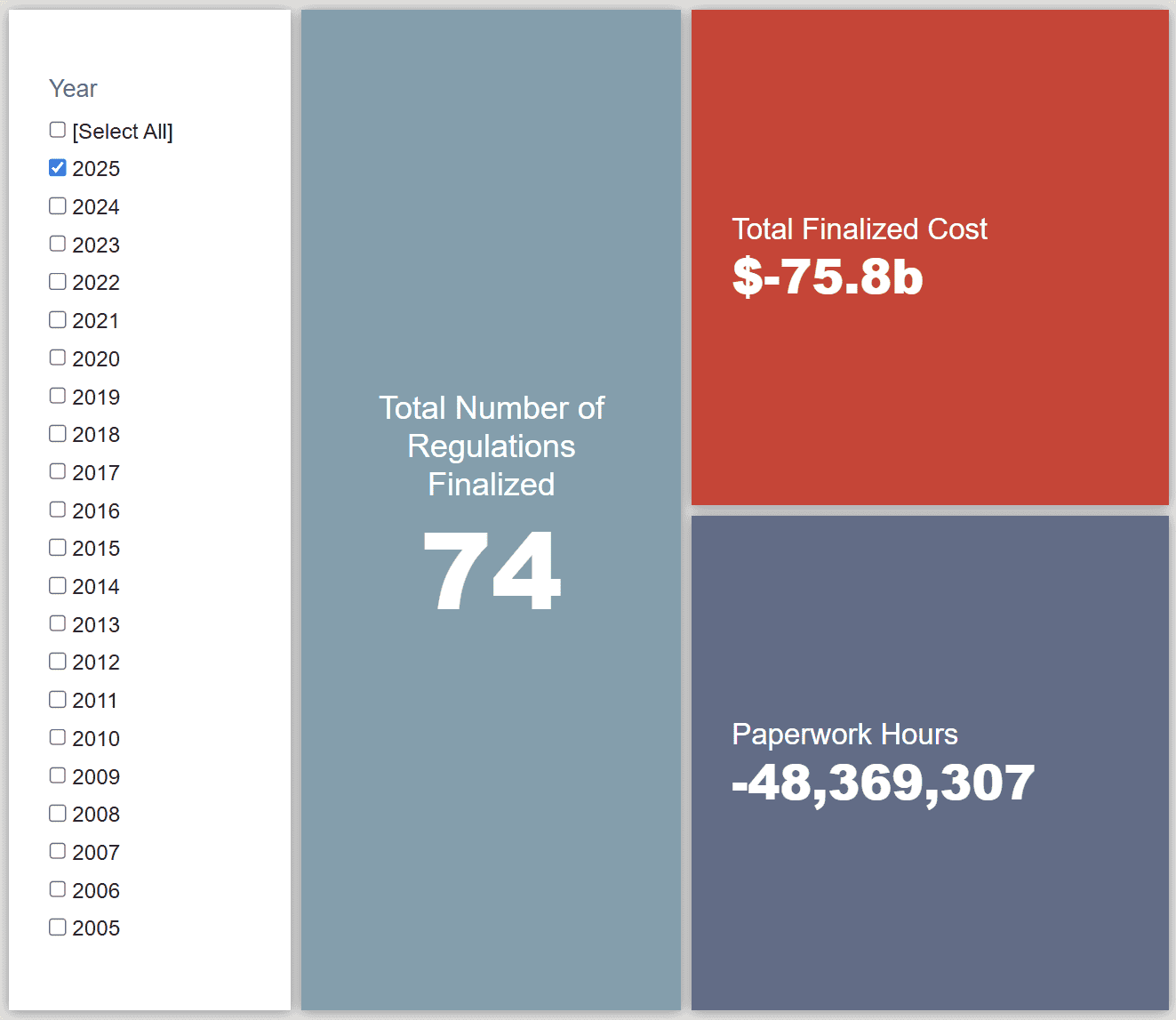
- 2025 Final Rule Costs: -$75.8 billion
- 2025 Proposed Rule Costs: $181.3 billion
NOTABLE REGULATORY ACTIONS
As noted above, it was another remarkably quiet week in the pages of the Federal Register. The only rulemakings with measurable effects were a handful of airworthiness directives, with the most significant being one focused on certain Airbus aircraft that could involve roughly $29 million in costs.
TRACKING TRUMP 2.0
In terms of announcements with substantive regulatory policy implications coming from the White House, it was a generally quiet week – until Friday afternoon, at least. As the country headed into the holiday weekend, President Trump issued a quartet of executive orders (EO) focused on bolstering and expediting the development of nuclear energy resources. Perhaps the most significant of the four from a regulatory perspective is the EO on “Ordering the Reform of the Nuclear Regulatory Commission [NRC].”
Beyond broad-based directives to reform the Commission’s “culture” and “structure” (see Sections 3 and 4, respectively), the EO also tasks NRC with proposing within the next nine months – and finalizing within 18 months – a series of rulemakings aimed at making various changes to its licensing and approval processes. Among the most notable of these policy prescriptions is the putative establishment of “a deadline of no more than 18 months for final decision on an application to construct and operate a new reactor of any type.” The EO represents yet another bold assertion of executive branch prerogative over an “independent agency,” which will likely invite some degree of controversy over the eventual rulemakings in question. Nevertheless, many of the policy points included therein are directionally in line with other recent reform efforts related to nuclear energy.
Not to be outdone, however, there were also some important decisions made by the judicial and legislative branches this past week. Regarding the former, the Supreme Court handed down an emergency ruling in Trump v. Wilcox that allowed the president’s removal of certain members of the National Labor Relations Board and Merit Systems Protection Board to remain operative for now. While the ruling in and of itself is a procedural and temporary decision, it suggests that a majority exists on the Supreme Court that, building off of the Selia v. CFPB decision, is willing to overturn the precedent set in Humphrey’s Executor v. U.S. that protected “independent agency” officials from presidential dismissal for reasons other than “for-cause” transgressions. As the Trump Administration continues to press on the actual independence of independent agencies, it is likely only a matter of time before the Court makes a substantive change on this precedent.
Across the street from the Supreme Court in the Capitol, the Senate finally took up consideration of the Congressional Review Act (CRA) resolutions of disapproval that would repeal series of Environmental Protection Agency (EPA) waiver determinations under the Clean Air Act that had allowed California to move forward with its own, more stringent, state-level emissions standards for vehicles. As the American Action Forum (AAF) has previously noted, the determinations in question represented – in more ways than one – fairly unique actions in relation to the CRA.
The proceedings that ensued to pass these resolutions were – to put it mildly – also quite unique. While the general expectation heading into this week was that Senate Republicans would need to stage a direct challenge to the ruling of the Senate parliamentarian on the resolutions’ statuses under the CRA, the actual course of action took a somewhat different route. The primary issue hinged on the seemingly mundane status of “points of order” raised during the consideration of CRA resolutions in the Senate.
As part of the “expedited consideration” process afforded by the CRA to the Senate, “points of order against the joint resolution (and against consideration of the joint resolution) are waived” to avoid their usage as a delaying tactic. During consideration of an otherwise unrelated CRA resolution, Majority Leader Thune challenged this presumption by asserting – in a point of order – that “sections 802(d)(1), 802(d)(2), and 802(d)(4) [of the CRA] are in conflict with one another.” After a series of votes that likely only excites extreme parliamentary procedure enthusiasts, the Senate ultimately affirmed that: A) points of order are in order under the CRA, and B) in regard to a particular point of order on the matter:
Joint Resolutions that meet all the requirements of Section 802 of the Congressional Review Act or are disapproving of agency actions which have been determined to be rules subject to the Congressional Review Act by a legal decision from the Government Accountability Office, be entitled to expedited procedures under the [CRA].
With this framework established, the upper chamber took up and advanced (by respective votes of 51-45, 51-44, and 49-46) the trio of CRA resolutions on the EPA waiver determinations that now head to President Trump’s desk for his expected signature.
Be sure to follow the AAF CRA tracker. As of today, members of the 119th Congress have introduced CRA resolutions of disapproval addressing 44 Biden-era rules that collectively involve $137.5 billion in compliance costs. Given the passage of the look-back window discussed above, it is highly unlikely any more resolutions of disapproval will be introduced this term. Since there are still outstanding resolutions that could move legislatively, however, AAF will continue to monitor and update such developments as appropriate.
TOTAL BURDENS
Since January 1, the federal government has published $105.5 billion in total net costs (with $75.8 billion in cost savings from finalized rules) and 69.5 million hours of net annual paperwork cuts (with 48.4 million hours coming from final rules).